
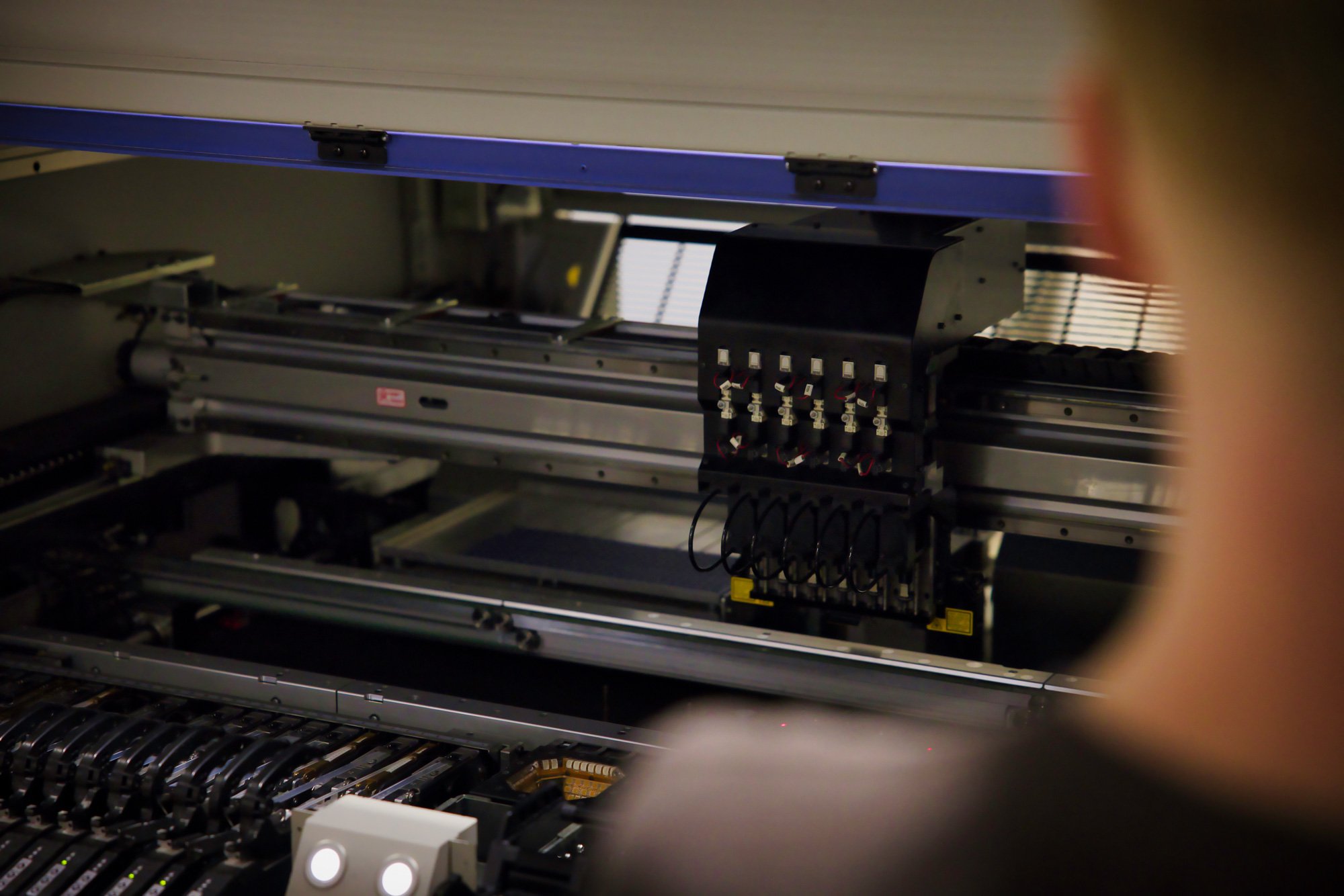
First Choice Assembly provides high-precision Surface Mount Technology (SMT) assembly services for businesses across the UK and Ireland. Using advanced SMT machines and a tightly controlled reflow soldering process, we deliver reliable SMT builds from prototype through to full production.
Whether you require high-density boards, LED SMD PCB production, or double-sided PCB reflow, our experienced team ensures every assembly is completed accurately, efficiently, and to recognised industry standards.
Book a Free Consultation
What Is AOI Inspection?
Automated Optical Inspection, or AOI, is a quality-control process used to inspect assembled printed circuit boards.
An AOI machine uses high-resolution cameras, controlled lighting and specialist software to check components, solder joints and board features for visible manufacturing defects. It helps identify problems such as missing components, incorrect polarity, poor alignment and soldering faults before boards move further through production.
At First Choice Assembly, we use the VCTA S910 3D AOI machine to inspect PCB assemblies quickly, accurately and consistently.
Interested in our AOI services?
Get in touch with our team and we can supply a detailed quote for your project requirements.
Contact
Advanced 3D AOI Inspection
Modern PCBs are becoming smaller, denser and more technically complex. Fine-pitch components and miniature solder joints can be difficult to inspect reliably by eye, especially across larger production runs.
Our 3D AOI system captures both flat images and measured height information. This allows us to assess component position, shape and visible solder characteristics in greater detail than conventional visual inspection alone.
The process helps us:
Detect manufacturing defects earlier
Improve consistency across production batches
Reduce unnecessary rework and waste
Support more reliable finished assemblies
AOI is used as part of our wider PCB assembly and quality-control process rather than as a standalone check.
See our other Services
How Does 3D AOI Work?
The PCB enters the inspection machine after component placement and soldering. Controlled lighting and projected patterns are used to capture detailed information about the board.
The software then compares the assembly against programmed inspection criteria. It checks areas such as component presence, orientation, position, height and visible soldering condition.
Any suspected defect is flagged for review by a trained operator. The technician can then confirm whether the result is a genuine fault and decide whether corrective work is needed.
This combination of automated measurement and human verification provides a fast inspection process while retaining experienced engineering judgement.
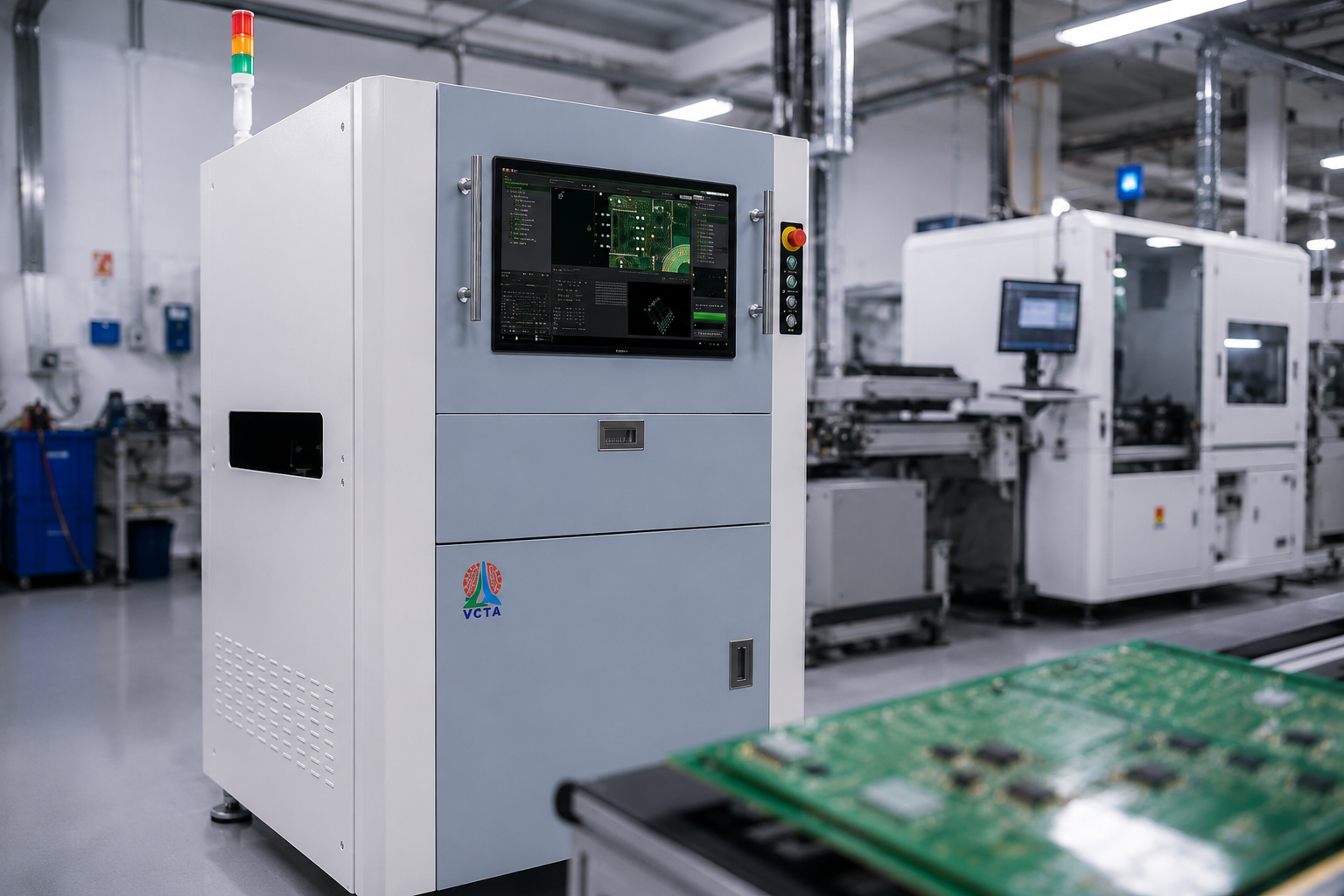
Why Use 3D AOI?
Manual visual inspection remains useful, but it can be limited by component size, board complexity and viewing angle. Results may also vary between operators or over long production runs.
Traditional 2D AOI improves consistency by examining flat images of the PCB. However, a two-dimensional image cannot always show whether a lead is lifted, a component is raised or a solder feature has an unusual height.
3D AOI adds measurable surface and height information.
The main advantage is earlier and more consistent defect detection. Finding a problem immediately after assembly is usually easier and less costly than finding it during final testing or after the product has been completed.
| Manual or 2D Inspection | 3D AOI Inspection |
|---|---|
| Primarily checks visible appearance | Checks appearance, position and height |
| May depend on viewing angle | Uses controlled imaging and projection |
| Height-related faults can be difficult to assess | Better suited to lifted or raised features |
| Manual checks may vary | Uses repeatable programmed criteria |
More Consistent Quality
The same programmed checks can be applied to every suitable board. This provides more consistent inspection across prototypes, small batches and repeat production.
Improved Reliability
Detecting placement and visible soldering faults helps lower the risk of avoidable assembly problems reaching the customer.
Key Benefits of AOI Inspection
Earlier Defect Detection
Faults can be identified soon after assembly, before boards move into later testing or final product integration.
Better Process Control
Inspection results can reveal repeated defects or process variations. This gives the production team useful information for investigating and improving manufacturing performance.
Reduced Rework
Finding issues earlier can reduce the time, labour and materials affected by a manufacturing defect.
Greater Production Efficiency
In addition to high-volume production runs, we also offer rapid prototyping and low-volume assembly services. This flexibility allows you to test designs quickly and cost-effectively, with the ability to scale up to mass production as needed.
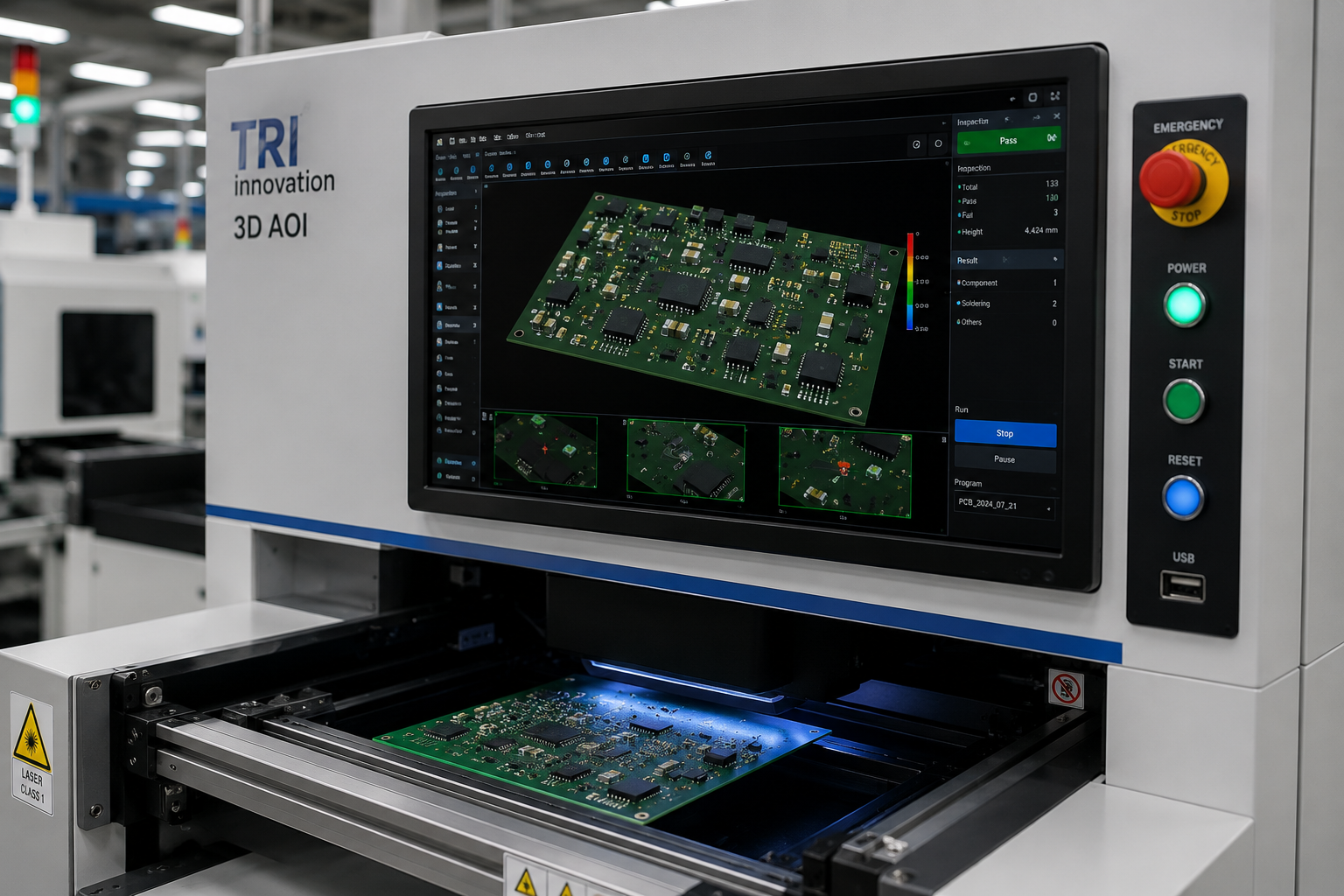
Our VCTA S910 3D AOI Machine
First Choice Assembly has invested in the VCTA S910 to improve inspection of modern SMT assemblies.
The system uses a 12-megapixel industrial camera, a telecentric lens, RGBW lighting and four-direction structured-light projection. These features allow it to capture detailed 2D and 3D information across the PCB.
The VCTA S910 supports inspection of very small components and fine-pitch assemblies. It can measure component height and identify surface variations that may not be clear from a standard overhead image.
Its capabilities include:
High-resolution imaging
Accurate 3D height measurement
Four-direction light projection
Inspection of miniature SMT components
Repeatable checking across complete batches
For customers, this means greater confidence when manufacturing compact, densely populated or technically demanding PCB assemblies.
Understand Industry Applications
What Defects Can AOI Detect?
AOI can identify a wide range of visible assembly defects. The exact results depend on the PCB design, component accessibility and the inspection programme used.
Commonly detected issues include missing or incorrect components, polarity errors, misalignment, lifted leads, tombstoning, solder bridges and visible variations in solder quantity.
The system may also flag damaged components, incorrect markings and dimensional differences that require technician review.
These defects can affect PCB performance in different ways. A solder bridge may create a short circuit, while a lifted lead may cause an open or intermittent connection. Detecting these issues early reduces the risk of faulty boards continuing through production.
Where AOI Fits Within PCB Assembly
AOI is an important inspection method, but it does not replace every form of PCB testing.
A typical production process may include component placement, reflow soldering, AOI inspection, technician review and electrical or functional testing where required.
AOI identifies visible assembly defects. It does not prove that every circuit operates correctly, and it cannot fully inspect hidden connections beneath components such as BGAs.
Depending on the board and application, AOI may be supported by:
Manual inspection
X-ray inspection
In-circuit testing
Functional testing
Using the right combination of inspection and testing methods provides a more complete understanding of PCB quality.
Explore Our PCB Assembly Services
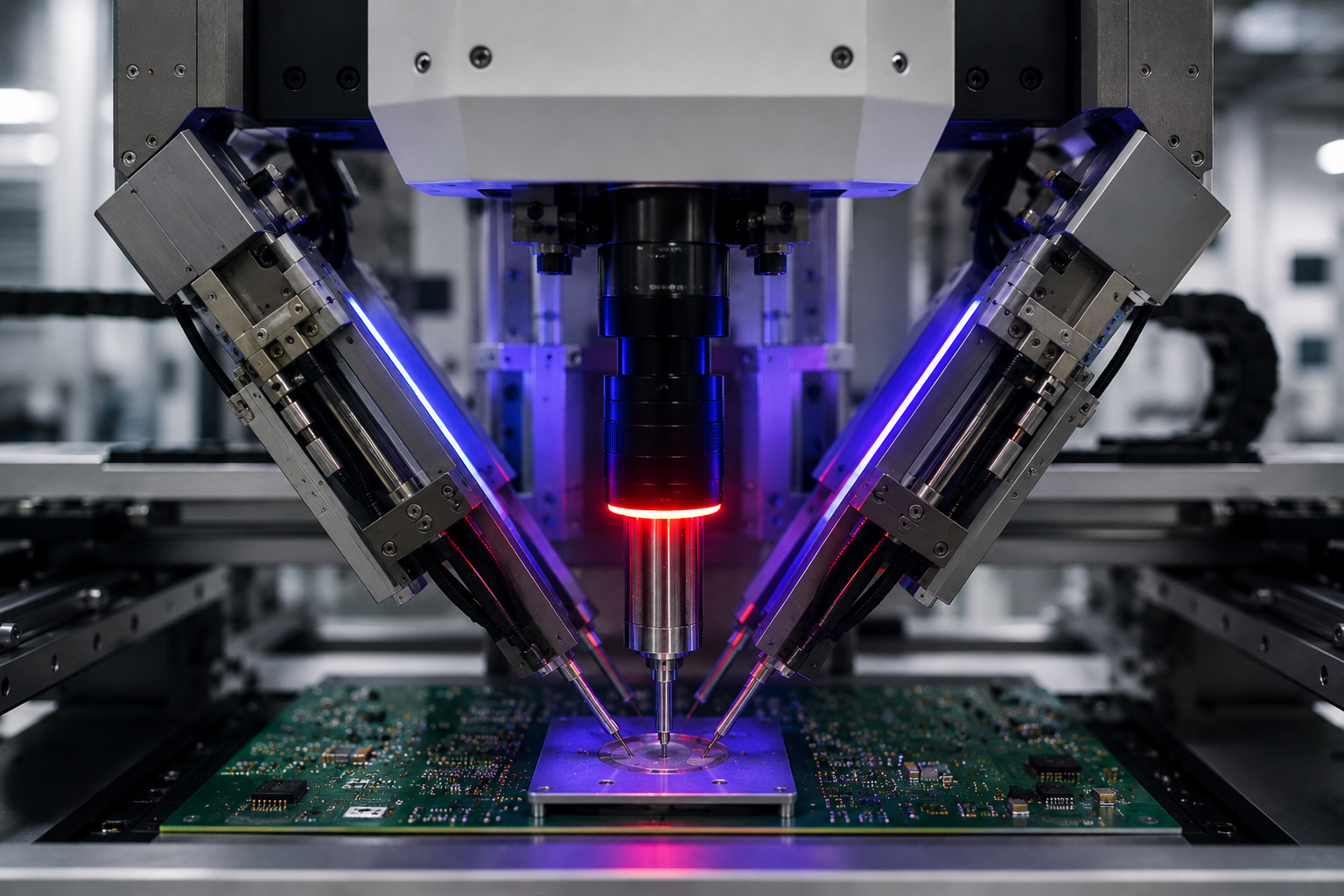
Full Turnkey SMT Solutions
First Choice Assembly offers complete turnkey surface mount technology assembly services, managing everything from component procurement to final PCB reflow and dispatch. Our streamlined processes ensure efficiency, traceability and dependable lead times for every project.
Why Choose First Choice Assembly?
Our 3D AOI capability is part of a complete UK-based PCB and SMT assembly service.
We support prototype builds, low-volume projects and repeat production. Inspection is carried out within a controlled manufacturing process by experienced technicians who review and verify the machine’s findings. Customers benefit from modern inspection equipment, UK-based manufacturing, clear communication and quality procedures supported by our ISO 9001:2015 quality management system.
Our investment in the VCTA S910 helps us identify defects earlier, maintain greater consistency and provide customers with greater confidence in every PCB assembly we manufacture.
Check our Certificates
Bespoke Design In-House
First Choice Assembly’s expert team provides custom PCB designs tailored to unique project specifications, bringing flexibility and precision to every build.
Lifetime Assurance
Our commitment to value is backed by a lifetime warranty against manufacturing defects. Underscoring our commitment to quality and providing long-term reliability for all manufactured products.
Request a PCB Assembly Quote
Send us your Gerber files, bill of materials, placement data and required quantities. Our team can review your project and recommend suitable assembly, inspection and testing processes.
Request a Quote
Automated Optical Inspection FAQs
-
AOI inspection uses cameras, lighting and software to examine assembled PCBs for visible manufacturing defects. It can identify missing components, incorrect polarity, placement errors and visible soldering problems before boards continue through production.
-
A 3D AOI machine captures height and surface measurements as well as standard images. This helps it assess component position, shape and raised features that may be difficult to judge from flat images alone.
-
AOI can identify missing, damaged, shifted or incorrectly oriented components, as well as lifted leads, tombstoning, solder bridges and visible soldering irregularities. Detection depends on the design and component accessibility.
-
3D AOI provides additional height and surface information. This makes it more useful for identifying raised components, lifted leads and other faults that may not be clear in a flat two-dimensional image.
-
The VCTA S910 provides detailed 2D and 3D inspection for modern PCB assemblies. It helps our technicians identify potential defects accurately and maintain consistent quality across production batches.
-
No. AOI automates detailed and repeatable checks, but trained technicians still review flagged areas, confirm genuine defects and assess anything that requires engineering judgement.
-
No. AOI checks visible assembly quality but does not confirm full electrical operation. Functional or in-circuit testing may still be needed to verify that the completed PCB works correctly.
-
AOI is usually completed after component placement and reflow soldering. This allows the system to inspect component position, orientation and visible solder quality before the board moves into later testing stages.
-
AOI is suitable for many SMT and mixed-technology assemblies. However, hidden solder joints, reflective surfaces and unusual board designs may require additional inspection methods such as X-ray or electrical testing.
-
AOI improves inspection speed and consistency, identifies defects earlier, reduces unnecessary rework and supports more reliable PCB production.